Analysis of Nigeria’s Social‑Security Situation-June 2026
Researcher No. 007
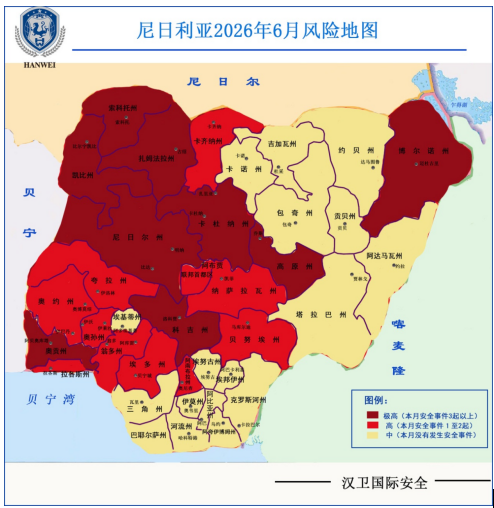
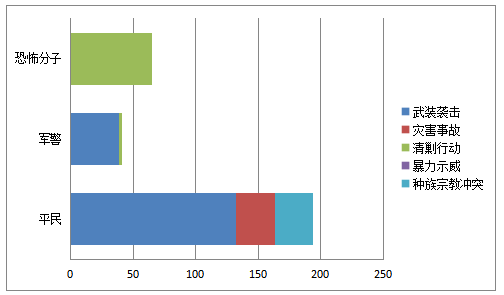
Based on monitoring reports from Hanwei International’s West‑Africa security officers and comprehensive media coverage, 73 security incidents were recorded across Nigeria in June 2026. These incidents claimed the lives of 207 civilians and 41 military‑police personnel, with at least 203 persons abducted. Major incident types included armed assaults and kidnappings, military counter‑insurgency operations and public‑safety accidents. Compared with the previous month, the number of security incidents rose by 14, fatalities increased by 58, and abductions went up by 58. Analysis shows that June recorded higher figures for security incidents, casualties and abductions than May, marking a further deterioration of the overall security environment. Notably, attacks targeting Chinese‑funded enterprises recurred this month. Hanwei International’s West‑Africa security officers issued two China‑related security early warnings, indicating severe and complex security risks facing Chinese‑funded entities, which demand high vigilance. Given the continuous deterioration of Nigeria’s security landscape, President Tinubu declared a national state of security emergency on June 12 to respond to persistent nationwide terrorist assaults, kidnappings and armed attacks. This marks the second time Nigeria has invoked a national state of emergency to counter armed violence and crime, following the one declared last November. In June, security risks were extremely high in central, north‑eastern and north‑central Nigeria, while other regions faced medium‑to‑high risks.
I. Comprehensive Analysis of Security Incidents
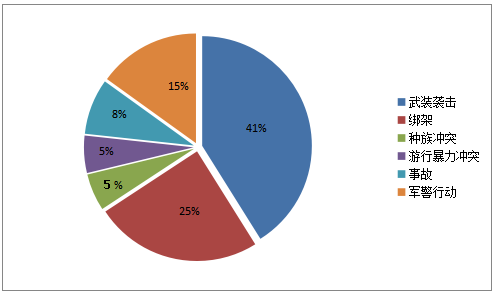
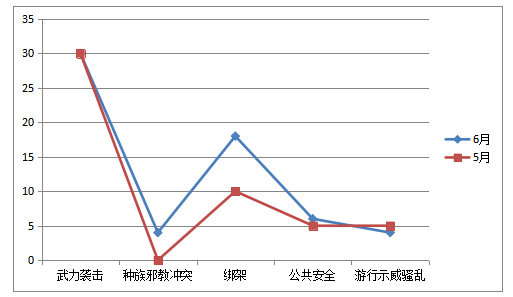
The 73 documented security incidents in June broke down as follows: 30 armed assaults (41 %), 18 armed kidnappings (24 %), 4 ethno‑religious clashes (5.4 %), 4 demonstrations‑turned‑violent (5.4 %), 6 public‑safety accidents (8.2 %), and 11 military counter‑insurgency operations (15 %). Combined, these events caused 313 fatalities and at least 204 abductions. Among the dead were 207 civilians, 41 military‑police personnel and 65 killed terrorists. Key features of the security situation are outlined below:
(I) Extremely‑high‑risk zones concentrated in the Northeast, Central and North‑Central regions
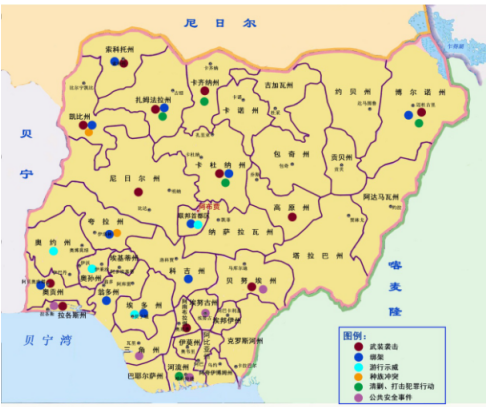
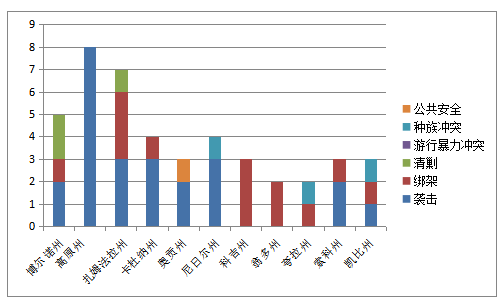
In June, security incidents clustered mainly in Borno State (Northeast), Plateau State (Central), and Zamfara State (North‑West). High‑risk areas also included Kaduna and Niger States (North‑Central) and Ogun State (South‑West). Plateau State recorded the highest risk level, with 8 incidents (predominantly armed assaults and kidnappings), a rise of 4 cases month‑on‑month, leaving 40 dead. Zamfara State followed with 7 armed‑attack and kidnapping incidents, killing 21 people and abducting 65. In the wake of a grave school abduction case in the prior month, Oyo State imposed a 48‑hour curfew across 10 Local Government Areas (LGAs) on June 24, later extended until June 27.
Hanwei International’s West‑Africa security officers released two early warnings concerning the safety of Chinese‑funded enterprises and Chinese nationals. The June 24 warning alerted that bandit groups planned to launch raids and abduct Chinese employees in Zurmi LGA, Zamfara State. Chinese‑funded organisations and individuals in vicinity were urged to enforce strict security protocols, avoid complacency and refrain from non‑essential outdoor travel. The June 26 warning stated that bandit factions plotted attacks and abductions targeting Chinese personnel in Edu LGA (Kwara State), Ajokuta (Kogi State) and parts of Niger State between late June and mid‑July. Relevant Chinese‑funded entities and residents were advised to strengthen security precautions and minimise unnecessary movement.
Separately, following an armed assault on a Chinese‑funded enterprise in Ogun State on June 8, the Chinese Consulate‑General in Lagos reminded Chinese‑funded firms and Chinese citizens within its consular jurisdiction to prioritise personal safety, avoid remote locales and crowded high‑risk venues, and reinforce on‑site security measures.
Figure 1: Schematic Distribution of Security Incidents in June
Chart 1: Statistics of Security Incidents by Major Region in June
(II) Frequent large‑scale armed assaults and kidnappings
A total of 48 armed‑attack and kidnapping incidents occurred in June, causing 191 fatalities and 204 abductions. Month‑on‑month, incident numbers rose by 8, deaths by 28 and abductions by 58. Large‑scale assaults and mass abductions were a defining feature; incomplete statistics show 18 incidents (38 % of total) with casualties or abductions exceeding 10 persons per event.
Early morning June 1: Armed bandits raided Ayegunle‑Bunu community, Kabba‑Bunu LGA, Kogi State, killing 2 and abducting 30 residents.
Early morning June 2: Hundreds of motorcycle‑riding assailants attacked Dangurbi community, Sokoto State, leaving at least 17 dead.
Night of June 8: A commercial Volkswagen Golf estate car was struck by an improvised explosive device on the Bagega‑Anka highway, Anka LGA, causing 10 casualties including 7 critically injured.
June 14: Lakurawa militants struck Fasken‑Rafi village, Arewa LGA, Kebbi State, killing at least 20 peopleEuropean U....
Afternoon June 16: Suspected armed bandits targeted an agricultural zone in Zurmi LGA, Zamfara State; 4 farmers were killed and over 20 abducted.
June 21: Armed assaults across Plateau State killed a minimum of 20 persons.
June 29: Gunmen attacked a school in Borno State (Northeast), killing 3, abducting 36 students and 3 teachers.
Amid worsening insecurity, President Tinubu re‑declared a national state of emergency on June 12 to address persistent terrorist attacks, kidnappings and other security crises. Nigeria had previously imposed a national emergency in November 2025 over grave security conditions. Media analysis cites multiple drivers for the renewed emergency: recurrent mass abductions of students and teachers; sustained armed raids across multiple northern and central states; surging highway kidnappings; and repeated calls from religious bodies, civil‑society organisations and northern elder councils for a formal national security emergency.
Measures under the emergency proclamation include: recruitment of 50 000 additional police officers (including previously approved intakes); substantial military troop expansion; raising the 2026 national defence‑and‑security budget to a historic high of 5.41 trillion Naira; accelerated roll‑out of the State Police system to boost local law‑enforcement capacity; and intensified joint military‑police operations against terrorist cells, kidnapper gangs and armed criminal networks.
(III) Two China‑related security cases
Two China‑linked incidents took place in June, resulting in 5 Nigerian fatalities with no Chinese casualties.
On the early hours of June 8, a Chinese‑funded enterprise in Ogun State came under armed assault. Six people died, including one assailant. Gunmen attempted to abduct Chinese workers on‑site. Upon receiving distress signals, a joint military‑police rapid‑response team deployed to the location. Firefights ensued, killing one Nigerian service member, wounding three security personnel and neutralising one attacker. Remaining raiders fled with 5 worker hostages. While fleeing, abductors murdered 4 hostages; one hostage escaped. Both the Nigerian Army and Ogun State Police issued official statements afterwards. The Army confirmed the joint patrol “foiled an abduction plot targeting Chinese nationals”. Preliminary police findings indicated the assault was specifically directed at the Chinese‑funded facility, unrelated to banditry, terrorism or herder‑farmer conflicts.
Foiled abduction plot against Chinese citizen. On June 11, Ogun State Police foiled a conspiracy to kidnap a Chinese national and arrested two principal suspects. According to police, intelligence‑led road interdiction apprehended the two men on the Ijebu‑Ode/Odogbolu highway on the afternoon of June 9. Investigations revealed the pair conspired to abduct a Chinese citizen for a ransom of 50 million Naira (approx. 250 000 RMB). One suspect worked as “translator‑driver” at a local firm employing Chinese nationals and planned to leverage his occupational access to carry out the kidnapping.
(IV) Multiple casualties from public‑safety incidents
Incomplete records show 6 major public‑safety accidents in June, killing 31 persons in total, covering traffic collisions, building collapses and boat sinkings.
June 8: Train derailment in Agbo, Ikanan LGA, Delta State: 3 dead, 35 injured.
June 13: Boat capsizing in Makurdi LGA, Benue State: at least 11 fatalities.
June 26: Three‑storey shopping‑mall collapse in Alakija, Lagos State: minimum 8 deaths.
Multiple disease outbreaks occurred across Nigeria this month.
First, the Lassa fever epidemic continued spreading across several states中国疾病预.... Nigeria Centre for Disease Control (NCDC) reports that as of June 7, cumulative national figures stood at 5 652 suspected cases, 855 confirmed cases and 148 deaths across 109 LGAs in 23 states, yielding a Case Fatality Rate (CFR) of 25.0 %. Compared with May, suspected cases rose by 618 and confirmed cases by 62.
Second, cholera outbreaks persisted in Borno, Plateau and other states. By early June, Nigeria registered 5 260 suspected cholera cases and 67 deaths nationwide. Plateau State reported 53 suspected, 11 confirmed cases and 5 deaths as of June 12. Borno State accumulated over 7 000 infections and at least 74 deaths within two months, accounting for 86 % of national caseloads. Federal medical teams have been dispatched to affected areas. International agencies including WHO and UNICEF deployed personnel to support local epidemic mitigation and clinical treatment中国疾病预....
Third, heightened vigilance against Ebola virus disease. Ebola spread across parts of Africa this month. The Democratic Republic of the Congo recorded 452 cumulative confirmed cases and 82 deaths; neighbouring Uganda registered 19 confirmed cases with 2 fatalities. To block cross‑border importation of Ebola, President Tinubu approved setting up a special task‑force on June 9 and allocated emergency funding of 10 billion Naira (approx. 49.8 million RMB). The task‑force will strengthen port quarantine, high‑risk flight screening, environmental disinfection, isolation‑facility activation and inter‑agency coordination. Funds are earmarked to upgrade national public‑health emergency‑response capacity中国疾病预....
(V) Sustained military counter‑insurgency operations
In June, Nigerian armed forces intensified operations against armed militants and criminal elements, focusing on the Northeast, Central and North‑Central zones. Large numbers of militants were killed, and 855 abductees rescued. According to the Director of Defence Media Operations, in the course of one week in early June, troops across operational theatres freed 388 hostages, neutralised 10 terrorists and arrested 31 suspects.
In the North‑West, security forces achieved notable results in Kaduna, Katsina and Zamfara States. On June 5, troops intercepted a vehicle at a road checkpoint along the Gusau‑Shinkafi highway in Zamfara State, seizing a locally‑manufactured 9 mm pistol, 1 002 rounds of 7.62×39 mm ammunition and other calibre ordnance. On June 7, security forces engaged militants in Tudun Wada village, Maru LGA, Zamfara State, arresting 8 suspected terrorists and confiscating 7 motorcycles, 30 mobile‑phone batteries, 19 handsets and 41 power banks.
In the Northeast, security forces maintained pressure on Boko Haram and Islamic State West Africa Province (ISWAP) militantsEncyclopae.... On June 6, multi‑axis military raids in the Mandara Mountains, Gwoza LGA, Borno State, successfully rescued 360 civilians. Between June 5‑11, troops intercepted multiple terrorist logistics suppliers across Adamawa, Borno and Yobe States, seizing large quantities of ammunition, communications gear and cash.
In the North‑Central zone, security forces arrested a high‑value wanted terrorist intelligence operative in Borgu LGA, Niger State on June 4, recovering propaganda audio recordings stored on mobile phones and MP3 players. Multiple search‑and‑rescue missions in Plateau State freed abducted passengers and apprehended suspects.
Within the Niger Delta, operations targeted illegal crude‑oil refining. Security teams uncovered illegal siphon installations and roughly 100 metres of pipeline in Okaki forest, Ahoada‑West LGA, Rivers State; approximately 1 200 litres of suspected illegally‑produced petrol were seized in Eket LGA, Akwa Ibom State.
In the South‑East, successive raids were carried out across Abia, Enugu, Imo and Ebonyi States, arresting numerous militants and confiscating large stockpiles of weapons and ammunition. Separately, on June 16, security forces launched “Operation Sweep III” in Katsina State, targeting terrorist strongholds within Matazu LGA and rescuing 7 abductees. The military stated these activities formed part of “Operation Fansan Yamma”, designed to curtail unimpeded movement of terrorists and bandits throughout the North‑West.
Chart 2: Breakdown of Security‑Incident Categories, June
Chart 3: Statistical Breakdown of Fatalities by Category, June
Chart 4: Comparison of Major Security‑Incident Counts: June vs May
II. Risk Early‑Warning & Mitigation Recommendations
Chart 5: Short‑Term Social‑Security Risk Early Warning for Nigeria
Risk‑rating definitions & scoring
表格
| Risk Level | Score Band | Tier | Regions & Cities | Hazard Sources |
|---|---|---|---|---|
| Extreme‑High Risk(17‑25 points) | Ⅰ(23‑25) | Level 1 | Borno, Zamfara and other North‑East / North‑West states | Boko‑Haram terrorist attacks, ethnic vendettas, military counter‑insurgency operations |
| Ⅱ(20‑22) | Middle‑Belt states such as Kaduna; southern oil‑producing states | Ethnic conflicts, Movement for the Emancipation of the Niger‑Delta (MEND) militants, kidnappings | ||
| Ⅲ(17‑19) | Offshore southern states (Gulf of Guinea e.g. Rivers State) | Pirate assaults, armed abductions, theft | ||
| High Risk(10‑16 points) | Ⅰ(15‑16) | Level 2 | Ogun, Oyo, Osun, Anambra States | Abductions, sporadic terrorist strikes |
| Ⅱ(13‑14) | Abuja, Lagos | Demonstrations, armed kidnapping, theft | ||
| Ⅲ(10‑12) | ||||
| Medium Risk(5‑9 points) | Ⅰ(8‑9) | Level 3 | ||
| Ⅱ(5‑7) | ||||
| Low Risk(1‑4 points) | Ⅰ(3‑4) | Level 4 | ||
| Ⅱ(1‑2) |
Note: Internal security‑risk assessment by Hanwei International.
Given Nigeria’s complex social environment and high‑risk security assessment, the following protective measures are recommended:
Full‑time security escorts for field travel. Remote rural areas suffer limited police coverage and poor road infrastructure; security‑force response times to violent crime and civil unrest are often heavily delayed. Chinese‑funded enterprises shall obtain up‑to‑date local security intelligence, conduct site‑specific risk assessments for all planned journeys, and deploy professional security personnel to accompany field missions.
Mitigate flood and heat‑wave hazards. Early June brought concurrent flood and extreme‑heat risks. Flash floods may trigger road inundation, transport disruption, damage to housing and farmland, drainage failure and water‑borne diseases. Extreme heat raises risks of heat exhaustion, heat‑stroke and meningitis outbreaks. Chinese‑funded organisations and Chinese nationals in Nigeria should monitor disaster alerts and maintain emergency preparedness.
Effective risk avoidance. Most attacks occur in the North‑East and North‑Central, notably Maiduguri (central Borno State), inter‑town highways, border zones adjacent to Niger Republic, and Zamfara State. Kaduna State and Abuja have seen surging security incidents recently. In the event of a terrorist attack, follow official instructions and liaise with contracted security providers for timely assistance. Install closed‑circuit surveillance at compounds, business premises, warehouses and residences. Fortify camp perimeters with trenches, high walls, barbed wire, anti‑vehicle barriers, buffer zones and alarm systems; augment static military‑police security and expand defensive perimeters. Avoid lingering near potential armed‑attack targets: government and security‑force installations, landmark buildings and religious sites. Minimize dwell‑time in high‑density public spaces across Nigeria: North‑East locales, religious‑festival venues, multi‑ethnic mixed communities, high‑crime zones (inter‑state highways, Gulf‑of‑Guinea pirate‑active waters), oil‑and‑gas infrastructure, government/military compounds, diplomatic missions, worship sites, schools, marketplaces, displaced‑person camps and public‑transport hubs.