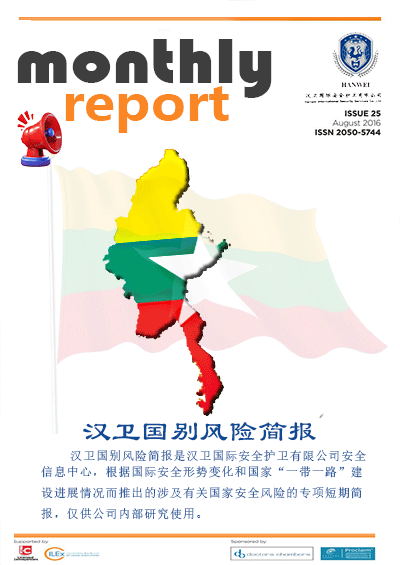
Myanmar Monthly Risk Report‑July
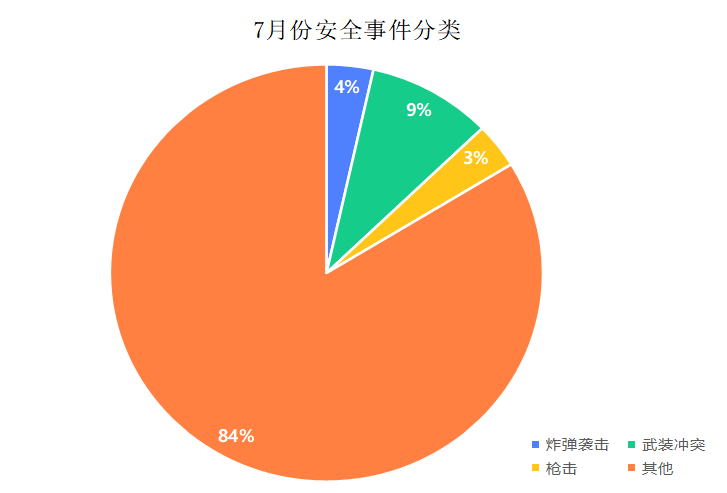
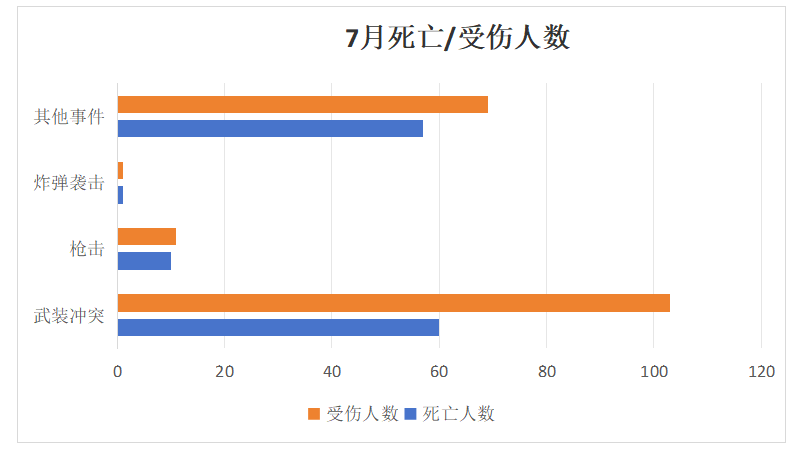
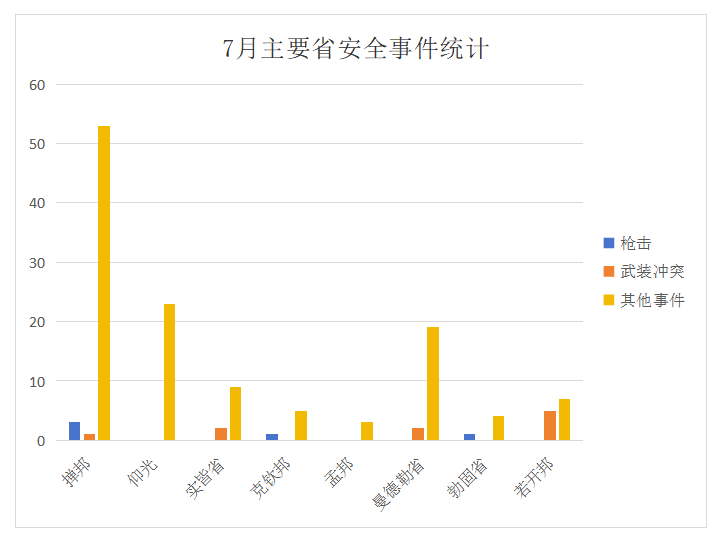
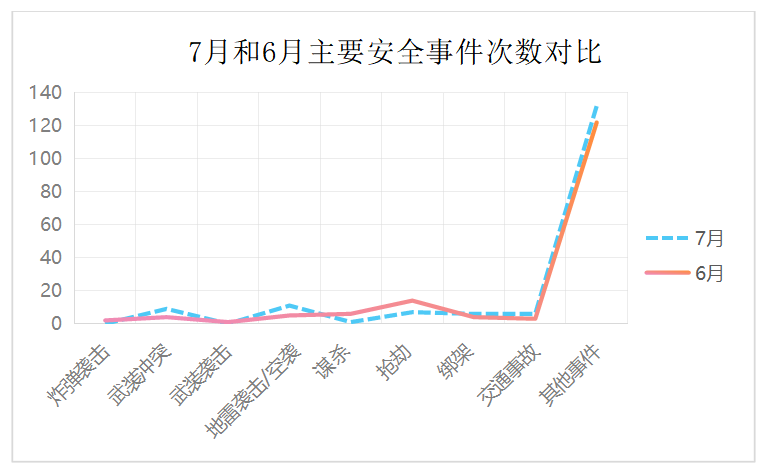
According to security‑public‑opinion monitoring reports from Hanwei International, 172 representative security incidents across Myanmar were documented in July 2026, 11 more than in June. These incidents caused 128 deaths and 184 injuries. Among recorded incident categories, armed conflicts and airstrikes predominated, with events concentrated in Shan State, Mandalay and other locales.
In July 2026, Myanmar’s military‑backed government made diplomatic breakthroughs: its Foreign Minister attended an in‑person ASEAN meeting for the first time in five years and held intensive engagements with China to consolidate bilateral cooperation. Militarily, the new Commander‑in‑Chief ramped up suppression via airstrikes, which had killed over 450 civilians in the first half of the year. Economically, the President called for capital reallocation toward agriculture, set up a 170‑billion‑kyat support fund and laid down rice‑export targets. On July 21, the Union Parliament voted to extend the validity of Legal‑Effect State‑of‑Emergency Decree No. 1/2026 for another 90 days.
Diplomatic Breakthrough and Deepening Engagement
From July 3 to 5, President Min Aung Hlaing paid an official state visit to Laos, marking the first state visit by a Myanmar leader to an ASEAN member state since the political upheaval. Bilateral cooperation focused on small‑scale, high‑impact projects, including signing a tourism‑sector memorandum of understanding and establishing sister‑city ties between Nay Pyi Taw (Myanmar’s capital) and Vientiane (Laos’ capital). Myanmar also donated 640 vials of anti‑snake‑venom serum to Laos.
On July 12, Myanmar Foreign Minister Than Maung Shwe attended the informal ASEAN Foreign Ministers’ Meeting, his first face‑to‑face engagement since the 2021 coup. This signalled a shift in ASEAN’s Myanmar policy from “isolation” toward “measured engagement”. Thai Foreign Minister Prakhida stated that this informal gathering represented the first meeting between ASEAN foreign ministers and Myanmar’s foreign minister post‑coup. It was expected to advance regional stability, lay foundations for security, trade, investment and tourism cooperation, and deliver long‑term benefits for Thailand and other ASEAN member states.
On July 22, Chinese Ambassador to Myanmar Ma Jia met Myanmar Tatmadaw Commander‑in‑Chief Ye Win Oo in Nay Pyi Taw. The two sides held in‑depth exchanges on China‑Myanmar military‑to‑military relations, Myanmar’s domestic security landscape and counter‑telecom‑fraud efforts. On July 23, Ambassador Ma Jia met Foreign Minister Than Maung Shwe to implement consensus reached by the two countries’ leaders. The Myanmar side reaffirmed its adherence to an independent, non‑aligned foreign policy. President Min Aung Hlaing is scheduled for an official visit to Thailand on August 6‑7 to further consolidate his regime’s legitimacy.
Curbing Speculation and Building an Agriculture‑Oriented Economy
On July 31, President Min Aung Hlaing delivered his 100‑day‑in‑office State‑of‑the‑Nation address. He criticised wealthy groups for speculative pursuits in real‑estate, gold and illicit foreign‑exchange markets, and urged capital flows into agriculture and manufacturing. Phased rice‑export targets were announced: Phase 1 aims for annual exports of 3 million tonnes of rice and broken rice; Phase 2 will lift the target to 5 million tonnes to restore Myanmar’s status as the “world granary”.
Disclosures during the Pyithu Hluttaw (People’s House) session on July 17 confirmed the establishment of a 170‑billion‑kyat MSME Development Fund, of which 150 billion kyat has been disbursed as loans to support micro‑, small‑ and medium‑sized enterprises. Repair of the main cables for the Myinta Suspension Bridge in Kalemyo has been designated a priority for FY 2026‑27; phased widening and reconstruction works will proceed on the Mongkai‑Pankhtu‑Keshi highway.
U Min Naung, Union Minister for Agriculture, Livestock and Irrigation, stated in a national‑media special interview on agricultural‑livestock development that the government targets 3.4 % GDP growth for FY 2026‑27. Noting that agriculture forms Myanmar’s economic foundation and that GDP growth reached only 1.9 % in FY 2025‑26, the government will strive to hit the 3.4 % growth objective in the new fiscal year.
As reported by AgroPages China: To accelerate “zero‑residue agriculture”, fully safeguard agricultural‑product safety and protect public health, Myanmar’s Pesticide Registration Committee passed a resolution at its 48th plenary session. It imposed a comprehensive two‑year ban on two toxic pesticides, Thiamethoxam and Clothianidin, and ordered all relevant entities to hand over remaining stockpiles in full by July 31 2026.
Launch of China‑Myanmar Cultural Exchange Week
On July 27, the 2026 China‑Myanmar Media Twin‑City Forum together with the “Mountains Bear Affection, Winds Carry Intent” China‑Myanmar Cultural Exchange Week grandly opened in Yangon — the forum’s first‑ever hosting inside Myanmar. More than 260 participants attended, including U Ye Tin, Deputy Minister of Information of Myanmar, alongside government, media, think‑tank and business representatives from both nations. Myanmar Radio and Television renewed its cooperation agreement with Yunnan Provincial Centre for South‑Asia‑Southeast‑Asia Regional International Communication; trial excerpts from the Burmese‑language edition of Guwen Guanzhi (An Anthology of Ancient Prose) were officially released.
Supporting events held during the programme included the China‑Myanmar Economic Corridor Think‑Tank Salon, “Auspicious‑Hopeful Farmlands” theatre sharing session, kick‑off shooting for the premiere episode of Tomorrow's Boss, the “Warp & Weft Among Mountains” thematic cultural‑experience exhibition, “Mountain Goods” bazaar, and “Dialogue · Bosom Friends” China‑Myanmar cultural showcase.
On July 16, Gao Ping, Chinese Consul‑General in Mandalay, published a signed article titled Carry Forward Millennium‑Old Pauk‑Phaw Friendship and Jointly Chart a Path of Development in The Mandalay Daily, a mainstream local newspaper within her consular jurisdiction. The article commemorated the 105th anniversary of the founding of the Communist Party of China, presented China’s development experience, and outlined prospects for China‑Myanmar friendship and cooperation in the new era.
Persistent Warfare and Tough New Anti‑Fraud Legislation
Ongoing civil war has displaced roughly 3.6 million people, creating a grave humanitarian situation. ACLED forecasts renewed airstrikes once the rainy season ends, potentially forcing more civilians to flee to neighbouring countries.
On July 4, the Second Ministerial‑Level Meeting of China‑Myanmar‑Thailand Joint Campaign against Telecom‑Network Fraud convened in Nay Pyi Taw, Myanmar. Relevant authorities of the three countries reached a series of consensus on deepening police‑law‑enforcement collaboration. They will continue joint tough crackdowns on telecom‑fraud operations in Myawaddy and other locations, fully dismantle fraud compounds, arrest all fraud‑related suspects, resolutely root out the breeding ground for such crimes, and effectively safeguard the legitimate rights and interests of people across the three nations. Since the start of this year, coordinated operations by Chinese, Myanmar and Thai authorities have delivered major results: more than 5 400 Chinese nationals implicated in fraud have been apprehended and repatriated en‑masse following intensive operations targeting Myawaddy fraud hubs.
On July 28, Myanmar’s Parliament voted to pass the Amendment to the Anti‑Online‑Fraud Law. It introduces the death penalty for persons who use violence, torture or illegal detention to force others to commit telecom‑fraud; operators of fraud centres may face maximum life imprisonment. Multiple major drug busts took place in Mandalay Region, Sagaing Region and elsewhere in July, seizing over 4.84 million stimulant pills and approximately 25.7 kg of heroin in aggregate.
On July 27, the Tatmadaw announced seizure of the New Zinzin and Old Zinzin villages along the Kale‑Dawu highway on the Myanmar‑India border, to restore control over this vital trade corridor. On July 31, Myanmar’s Union Parliament formally enacted the Anti‑Online‑Fraud Law. Its stated objectives are: prevent the establishment and expansion of online‑fraud activities within Myanmar; strengthen coordination and cooperation with foreign governments, complementing domestic capabilities to jointly combat online fraud; safeguard national sovereignty and social stability; thoroughly investigate and legally punish online‑fraud offenders; and protect the public from harm and economic losses inflicted by online fraud. Under the law, the Union Government shall set up a Central Committee for Combating Online‑Fraud chaired by the Union Minister of Home Affairs, with a total membership of 21 persons.
Persistent Bomb Attacks and Armed Clashes
On the morning of July 2, revolutionary forces in Male Township, Mandalay Region intercepted a Tatmadaw military column. Ten Tatmadaw soldiers were killed, others surrendered, and weapons‑ammunition were seized.
On July 4, fierce fighting intensified in Lemyethna Township, Ayeyarwady Region. The Tatmadaw launched a large‑scale offensive to seize key segments of the strategic Pathein‑Monywa highway, contested by a coalition led by the Arakan Army (AA). Severe infrastructure damage hit several highway sections, triggering strict security blockades and halting all civilian traffic along this vital western transport artery.
On July 12, junta troops clashed with a coalition of Chin resistance forces near Tabin Village. Heavy fighting killed approximately 12 junta soldiers. The military is currently attempting to defend villages along the Bauk‑Kyawhtu route to secure its supply lines.
On July 28, intense battles persisted between government troops and combined Arakan Army (AA) forces along the boundary between Ayeyarwady Region and Rakhine State. The military kept reinforcing troop deployments and conducting successive airstrikes. Using warships and amphibious landings, government forces continuously delivered weapons, supplies and reinforcements to their outposts in Shwe Nyaung Yan, Ye Gyi, Da Bon, Ingyaw and Lemyethna townships along the Ayeyarwady‑Rakhine border, launching counter‑offensives against AA units.
On July 17, a moderate‑magnitude earthquake (magnitude 5.3, focal depth 6 km) struck Debein town, roughly 56 miles north of the Mandalay Seismic Observatory. Strong shaking persisted for a long duration, sparking public alarm and panic.
Hanwei International Recommendations
Strengthen personal safety precautions; master earthquake self‑rescue knowledge and stock emergency supplies including drinking water, food and disaster‑relief first‑aid kits.
Closely monitor seismic updates, meteorological early‑warnings and disaster‑prevention information; keep communication devices accessible; guard against secondary hazards such as aftershocks, landslides, fires and infectious diseases.
Myanmar Police Emergency: 0095‑199
Myanmar Medical Emergency: 0095‑192
Consular Protection & Assistance, Chinese Consulate‑General in Mandalay: 0095‑9‑259172726
Consular Protection & Assistance, Chinese Embassy in Myanmar: 0095‑9‑43209657
24‑Hour Global Consular Protection & Service Hotline of China’s Ministry of Foreign Affairs: 0086‑10‑12308 or 0086‑10‑65612308
Chart 1: Breakdown of Security Incidents, July
Chart 2: Statistical Breakdown of Deaths / Injuries, July
Chart 3: Security‑Incident Statistics by Major State/Region, July
Chart 4: Comparison of Major Security‑Incident Counts: July vs June