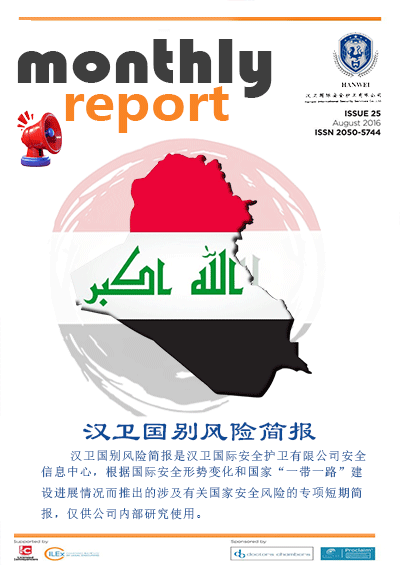
On April 29, Zhongman Petroleum released its Q1 2026 financial report, posting operating revenue of RMB 771 million and net profit attributable to parent shareholders of RMB 31.6551 million, dropping 18.22% and 86.22% year-on-year respectively. The drastic profit decline was mainly driven by economic volatility stemming from protracted geopolitical conflicts across the Middle East. Against this backdrop, enterprises operating in Iraq are specially advised to rigorously enforce security risk prevention and control protocols to safeguard staff and corporate assets.
I. Political and Economic Developments
(I) Deadlocked Cabinet Formation amid Internal Factional Infighting and External Power Plays
Internal power struggles: As the statutory deadline for designated Prime Minister Ali Al-Zaidi to form a cabinet loomed large, major Iraqi political blocs ramped up behind-the-scenes maneuvering. Multiple Sunni political factions competed fiercely for pivotal cabinet posts; deep rifts emerged within Shia communities over core power allocation. Mounting pressure from Kurdish political forces and local regional groups further stalled the cabinet-building process, forcing delays in both the submission of cabinet rosters and parliamentary confidence votes. Disarmament requirements for armed militias became another flashpoint of contention, with unconfirmed reports suggesting Prime Minister Zaidi contemplated abandoning his cabinet formation mandate entirely. During the parliamentary confidence vote session, lawmakers endorsed the government’s policy agenda and confirmed appointments for 14 core cabinet positions, yet nominations for remaining portfolios failed to secure parliamentary approval, leaving the cabinet structurally incomplete.
Without parliamentary confirmation for ministers heading core portfolios including Defense and Interior, Iraq’s central government has seen drastically weakened oversight over domestic law enforcement, counterterrorism operations and border management, raising risks of surging street crime and illegal firearm possession. Concurrently, sustained foreign meddling compels various Iraqi armed factions to beef up military readiness to defend their interests and national sovereignty, lifting the odds of sporadic armed skirmishes.
(II) Cumulative Crises Trap Iraq’s Economy in Severe Difficulties
Five core sectors – public finance, services, energy, sovereign debt and infrastructure construction – faced cascading crises across May.
Public finance: Iraq’s Ministry of Finance released updated fiscal data on May 4, revealing total national fiscal revenue hit approximately USD 12 billion for January–February 2026, down 13% year-on-year, with oil-derived proceeds accounting for 84% of total income. Government spending for the first two months already outstripped concurrent revenue, as rigid expenditures such as civil servant payroll and social welfare payouts consumed a dominant share of fiscal outlays, resulting in a stark revenue-spending imbalance.
Services: Sustained geopolitical tensions delivered a heavy blow to Iraq’s domestic tourism sector: nearly 60% of local restaurants and hotels suspended operations; cross-border outbound travel and religious pilgrimage activities ground almost to a halt, triggering mass layoffs across tourism-related industries and collateral damage to non-oil economic segments.
Energy: With summer temperatures in Iraq set to near 50°C, overlapping headwinds of geopolitical strife, international sanctions and fiscal crunch disrupted conventional energy supply chains, putting Iraq’s national power grid on track for its worst electricity shortage in years. Official projections put peak summer power demand at 40 GW against existing installed generation capacity of merely 29 GW, leaving a substantial supply shortfall.
Sovereign debt: Per Ministry of Finance statistics dated May 8, Iraq’s domestic outstanding debt reached USD 73.8 billion as of end-April 2026, while external foreign debt fell to USD 10.076 billion. The bulk of national debt burden has shifted from external creditors to domestic lenders, steadily inflating fiscal pressure.
Infrastructure: Iraq’s federal annual budget has failed parliamentary approval for 16 consecutive months, with draft budgets for FY2025 and FY2026 left pending indefinitely. Thousands of nationwide infrastructure projects covering schools, municipal water supply and other people’s livelihood-critical works have been suspended as a direct consequence.
Mounting economic hardship has severely compromised public welfare, stoking widespread popular discontent and waves of street protests that constantly threaten urban public order.
Sulaymaniyah Attacks: The Kurdistan Regional Security Committee of Iraq confirmed the Surdash refugee camp housing displaced Kurdish opposition members came under successive strikes by two missiles and three unmanned aerial vehicles (UAVs) within a 24-hour window, causing structural damage to surrounding public infrastructure with no immediate human casualties reported. Separately, a camp belonging to Iran’s Komala Kurdish faction in Surdash, Sulaymaniyah Governorate, sustained a missile bombardment.
II. Other Security Developments
(I) Domestic Public Security Risks
Armed Conflicts: A long-running clan feud erupted into large-scale armed clashes at Asyan Village, Sheikhhan District, Duhok Governorate, killing three people and wounding multiple others; a subsequent retaliatory raid by one faction left two additional fatalities. On May 4, a funeral gathering in Baghdad’s Sadr City devolved from verbal disputes between rival tribes into gunfights and melees, leaving one dead and two injured. In Garraf, Dhi Qar Governorate, lingering inter-group grievances sparked vicious brawls that injured nine civilians including one member of the Popular Mobilization Forces (PMF) and a licensed lawyer. On May 11, a premeditated armed shooting outside a police station gate in Kushtepe, Erbil Governorate killed two officers. On May 25, a petty dispute over power cable wiring between five local residents and a private power generator operator in Baghdad’s Al-Ghazaliyah District escalated into a chaotic shootout with two fatalities on site.
Security Recommendations for Chinese Enterprises and Nationals in Iraq
Corporate-level Precautions
Maintain political neutrality to steer clear of factional and geopolitical conflict fallout. Establish a round-the-clock on-site security monitoring mechanism to track real-time security advisories released by China’s Embassy and Consulates in Iraq plus credible local official media; continuously monitor movements of Iraqi political blocs, armed groups, protest schedules and emergency alerts. Refrain from commenting on or intervening in domestic factional infighting; ban all staff from participating in or weighing in on Iraqi partisan and sectarian disputes, maintaining no undisclosed private contact with any political party or militant organization and avoiding rallies, demonstrations and military activity zones entirely.
Upgrade physical site security to fend off external threats. Reinforce defensive setups at office compounds, project camps and material warehouses with contracted professional security personnel on shift duty. Suspend all nonessential field assignments, cross-governorate business travel and client visits; avoid high-risk precincts including government premises, Baghdad Green Zone, protest plazas and militant strongholds. Conduct targeted emergency drills covering civil unrest, random shootings, abduction and drone attacks, finalizing pre-planned evacuation routes and muster points to enable fast, orderly emergency relocation prioritizing personnel survival.
Individual-level Precautions
Minimize outdoor exposure and social risks. Adhere strictly to the non-essential no-outing principle; avoid solo nighttime travel, opting for daytime paired excursions with professional security escorts where available. Steer clear of crowded open markets, public squares, government building peripheries, diplomatic quarters and militant operational zones. Exercise prudence in personal social interactions, refrain from befriending unknown strangers arbitrarily and never post residential address, asset information or work details on social media platforms to mitigate robbery, theft and extortion risks.
Prepare pre-emptive contingency plans and stay composed amid emergencies. When caught up in armed skirmishes, mass unrest or drone strikes, take immediate nearby cover without fleeing blindly, crowding around incident scenes or taking photos to avoid stray fire or stampede injuries. Carry photocopies of personal identification documents routinely and cooperate fully with security screening by Iraqi police and military personnel to prevent unnecessary confrontations. In the event of robbery, theft or kidnapping, comply with perpetrators’ demands to preserve personal safety while discreetly collecting case clues pending rescue support.
Emergency Contact Information
Iraq Police Hotline: 130