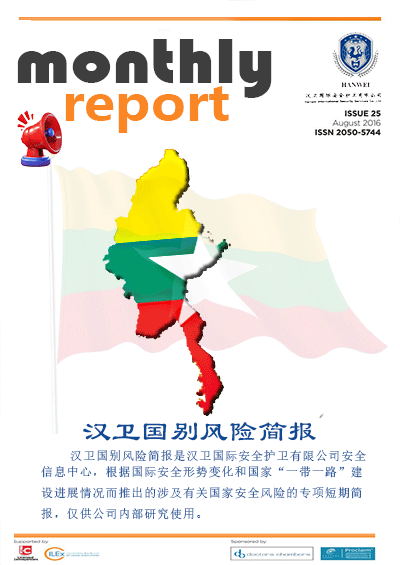
Monthly Risk Bulletin for Myanmar
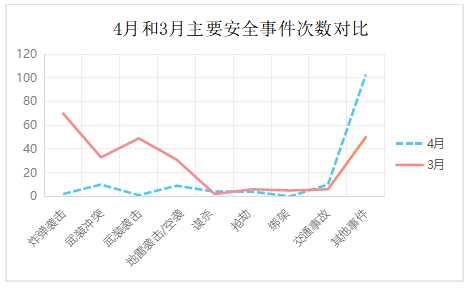
Per public opinion and security monitoring reports from Hanwei International, a total of 143 representative security incidents were recorded across Myanmar in April, rising by 109 cases month-on-month against March’s figure. These incidents left 86 fatalities and 145 injured persons overall, predominantly consisting of armed confrontations and airstrikes concentrated in Mandalay Region and Shan State.
I. Political & Diplomatic Developments
1. Inauguration of New Administration
Domestic agenda: A 100-day special governance campaign was rolled out to advance peace reconciliation, education upgrading, agricultural livelihood improvement and infrastructure construction. A presidential amnesty freed over 4,000 inmates including former President Win Myint as a goodwill gesture. Veteran military personnel retain control over core portfolios such as national defense; the appointment of Myanmar’s first female Karen Vice President Nann Nyi Nye and the establishment of the Ministry of Women’s Affairs signal inclusive governance arrangements.
External balanced diplomacy: During his meeting with Chinese Foreign Minister Wang Yi on April 25, President Min Aung Hlaing defined China-Myanmar ties as Myanmar’s most vital bilateral relationship, pledging zero tolerance for activities harming China’s legitimate interests and intensified crackdown on online gambling and telecom fraud.
2. Advancement of National Peace Agenda
April 20–21: President Min Aung Hlaing unveiled the 100-Day Peace Initiative at the Union Government Conference in Nay Pyi Taw, formally inviting all armed factions to join peace talks and setting July 31 (within the first 100 days of the new administration) as the negotiation deadline; the administration warned unreasonable preconditions would trigger official countermeasures.
April 24: NSPNC convened its maiden session to discuss peace process resumption and review historical ceasefire accords.
April 25: Chinese Foreign Minister Wang Yi paid an official visit to Nay Pyi Taw for meetings with President Min Aung Hlaing and Foreign Minister Tin Maung Shwe. China voiced full support for Myanmar’s new governance agenda; Myanmar reiterated adherence to the one-China principle, endorsement of China’s four major global initiatives, commitment to eradicate cyber fraud and safeguard safety of Chinese citizens, institutions and investment projects in Myanmar.
II. Economic Pressure & Natural Disasters
1. Frequent Geological Disasters & Communication Outages
April 1: Magnitude 4.2 earthquake struck Rakhine State;
April 12: M3.8 quake 43 miles southeast of Kanbalu Town (focal depth 11km), plus a M3.6 tremor 18 miles east of Zunla Town at 15km underground;
April 21: Two successive earthquakes measuring M4.6 and M4.3 hit within a single day.
2. Currency Intervention & Surging Commodity Prices
April 9: Myanmar’s Central Bank intervened in foreign exchange market by injecting USD 49 million for fuel imports and USD 8.16 million for edible oil procurement to curb currency depreciation.
Post-Water Festival (mid-April): Domestic staple food prices jumped 20%–35% on average, with palm oil skyrocketing by 80%, drastically inflating household living expenses.
April 18: Union Minister of Electricity and Energy led an official delegation to Guangzhou for inspection of waste-to-energy incineration projects to resolve nationwide solid waste crisis.
April 21–24: The central bank continued regular USD auctions to edible oil and LPG importers for exchange rate stabilisation.
III. Armed Conflicts & Violent Attacks (April Full Month)
- Northern Shan State (Early April): Ta’ang National Liberation Army (TNLA) OffensiveThe TNLA seized multiple military outposts including Kyaukme amid large-scale ground assaults.
- Nationwide Airstrikes & Civilian Casualties (Early April)
Apr 1: Famous Ngwe Saung coastal resort beach in Thandwe Township, Rakhine State was bombed in an airstrike, killing four civilians including two children and injuring three more.
Apr 2: Military fighter jets carried out successive aerial bombardments across Mawonke, Mawonle, Pabin, Yuma Village and Mahikatau Ward, followed by another round of strikes targeting Homalin at 14:21 local time.
Apr 3: A drone-borne explosive device detonated in Mandalay Region in a targeted bombing.
Apr 14: Random gun assaults by armed militants against civilians in Mon State left 2 dead and 1 wounded.
- Intense Combat in Kayah State (Mid-April)Kayah Army and allied ethnic armed groups besieged Loikaw, capital of Kayah State, with repeated assaults on core military strongholds.
- Escalated Government Airstrikes in Rakhine State (Late April)
Apr 23–24: Frequent fighter jet raids against Ngwe Saung and surrounding settlements in Thandwe; renewed heavy bombardment on Thandwe Township on Apr 28 triggering heavy civilian casualties.
Apr 30: Military authorities announced recapture of Indaw Township; concurrent government airstrikes across Mon State displaced over 13,000 local residents.
IV. Risk Prevention Advice from Hanwei International
Corporate Recommendations
Immediately revise onsite security contingency plans and upgrade physical fortifications including perimeter walls and blast-resistant installations at construction camps and project compounds.
Conduct comprehensive background vetting on all locally recruited Myanmar staff to guard against insider-colluded theft and sabotage.
Suspend non-essential field visits to high-conflict zones covering Sagaing Region and southern Mandalay (Myingyan, Natogyi etc.). Where field travel is mandatory, contract licensed professional security escorts and avoid dawn and night shifts.
Individual Precautions
Emergency Hotlines
Attached Charts Summary:Chart 1: Categorised breakdown of April security incidentsChart 2: Statistical classification of April fatalities & wounded cases
Chart 3: Regional distribution of security incidents by province/state
Chart 4: Month-on-month incident comparison (Apr vs Mar)