Analysis of Nigeria’s Social Security Situation – January 2026
Researcher No. 007
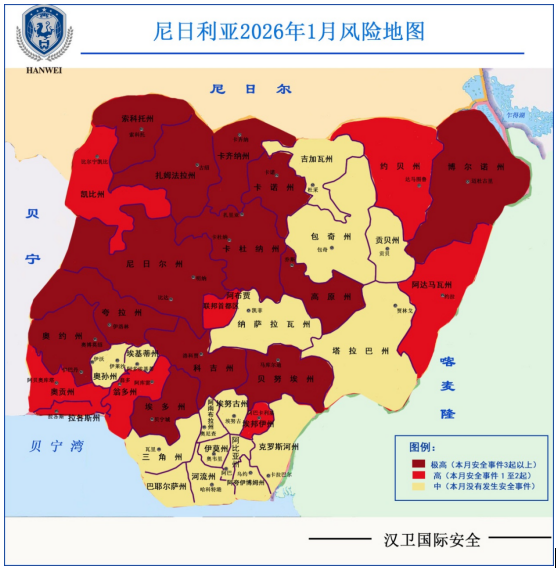
Based on monitoring reports from Hanwei International’s West Africa Security Officer and comprehensive media coverage, 87 security incidents were recorded across Nigeria in January 2026. These incidents resulted in 264 civilian fatalities, 53 security force fatalities, and at least 388 abductions. The main incident types include armed attacks and kidnappings, military clearance operations, and public safety accidents. Compared with the previous month, the number of security incidents rose by 10, fatalities increased by 130, and abductions rose by 146.
Analysis indicates that Nigeria’s security situation deteriorated sharply in January, coinciding with the year-end and New Year period, with a significant surge in both incident frequency and fatalities. Large‑scale armed attacks and kidnappings remained rampant in Benue, Kogi, and Plateau States (central region); Zamfara and Kaduna States (north‑central region); and Borno State (northeast). Militants employed advanced equipment such as drones to target military installations, causing heavy casualties. Security risks are extremely high in central, mid‑western, and northeastern Nigeria, and high in other regions.
I. Comprehensive Analysis of Security Incidents
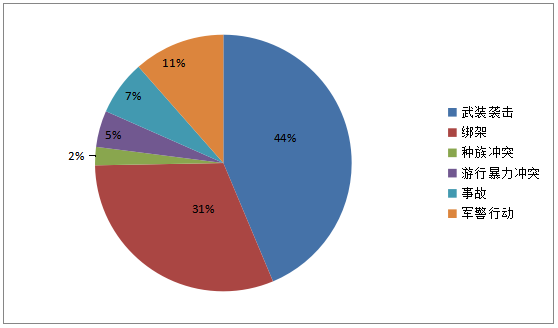
The 87 security incidents in January comprised:
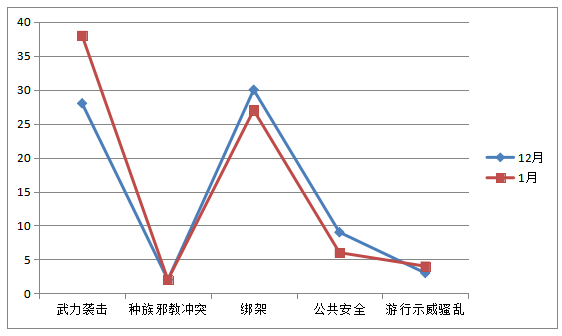
38 armed attacks (43%)
27 armed kidnappings (31%)
2 ethnic conflicts (2%)
6 public safety incidents (6.8%)
10 military clearance operations (11%)
4 protests and demonstrations (4.5%)
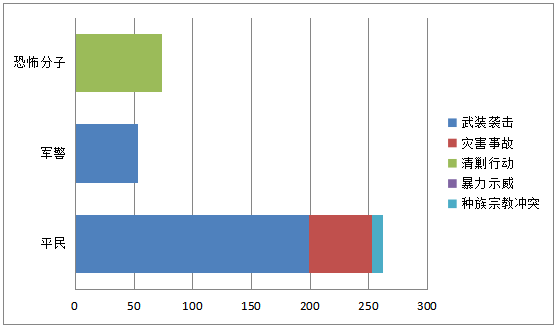
Collectively, these incidents caused 391 fatalities and at least 388 abductions. The fatalities breakdown: 264 civilians, 53 security personnel, and 74 terrorists killed in operations. The overall security situation exhibited the following characteristics:
(1) Extremely High Risk in Central, Mid‑western, and Northeastern Nigeria
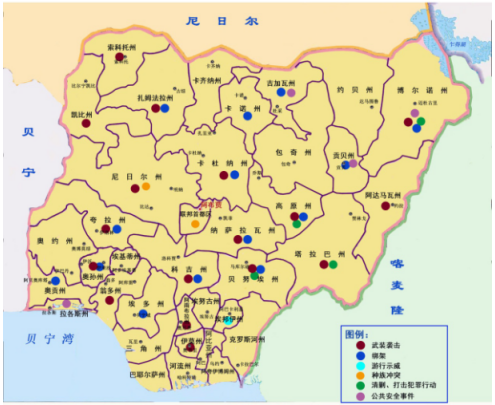
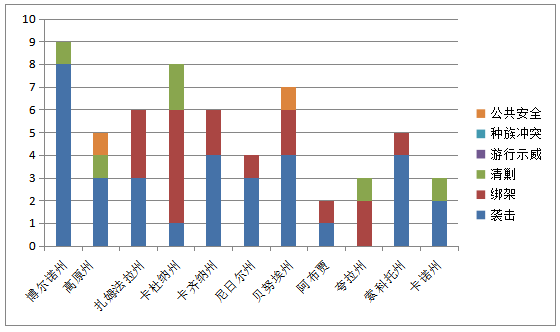
Security incidents were concentrated in Borno State (northeast), Benue State (central), Kaduna State (north‑central), and Zamfara State (mid‑western). High‑risk zones also included Niger, Katsina, Plateau, and Kogi States.
Borno State (highest risk): 9 incidents (up 2 from December), dominated by armed attacks and kidnappings, resulting in 69 fatalities. A notable feature was repeated strikes on military facilities: 5 attacks killed 33 soldiers.
Kaduna State (north‑central): 8 incidents (up 5), primarily armed attacks and kidnappings, causing 13 fatalities and 227 abductions—a sharp rise in abductions. On January 18, three churches in Kurmin Wali Community, Kajuru LGA were attacked, killing 3 and abducting 177. This incident drew widespread domestic and international attention; U.S. Congressman Riley Moore called the abductions “shocking” and urged the Nigerian government to secure the victims’ safe and rapid return.
On January 26, Hanwei International’s West Africa Security Officer issued a security alert: criminal gangs planned attacks on foreign nationals, especially Chinese citizens, targeting Oyo, Ogun, Kwara, Kano, Kaduna, Jigawa, Niger States, and the Federal Capital Territory (Abuja). Chinese enterprises and individuals were advised to enhance security and avoid non‑essential travel.
On January 28, the Chinese Embassy in Nigeria issued a security reminder: amid persistent instability and a surge in violent crimes targeting foreigners ahead of the Chinese Spring Festival, Chinese companies and citizens in Nigeria were urged to strengthen security awareness, eliminate complacency, conduct thorough safety audits, upgrade on‑site security, and safeguard personnel and assets. In emergencies, contact local police and the embassy/consulate immediately.
(Figure 1: Distribution of Security Incidents – January 2026)
(Chart 1: Statistics of Security Incidents by Major Region – January 2026)
(2) Persistent Surge in Armed Attacks and Kidnappings
Nigeria remained under a state of security emergency in January. Despite intensified counter‑terrorism operations by security forces, armed attacks and kidnappings rose sharply, exceeding December levels. A total of 65 armed attacks and kidnappings occurred, causing 251 fatalities and at least 388 abductions—an increase of 7 incidents, 64 fatalities, and a corresponding rise in abductions.
Joint task forces operated under adverse conditions (rough seas, poor visibility) to successfully repel hijackers. On January 18, the Northeast Joint Task Force, Operation Hadin Kai, conducted clearance operations against Boko Haram and its affiliate Islamic State West Africa Province (ISWAP) camps in the Timbuktu Triangle of Borno State, destroying underground logistics storage facilities near the camps.
Security forces also continued crackdowns on illegal mining. On the night of January 9, the Department of State Services (DSS) and the Federal Ministry of Solid Minerals Development jointly raided illegal mining operations in Ilorin, Kwara State, seizing 7 trucks loaded with illegally mined lithium ore.
(Chart 2: Breakdown of Security Incidents – January 2026)
(Chart 3: Fatalities by Category – January 2026)
(Chart 4: Comparison of Major Security Incidents – January vs. December 2025)
II. Risk Warnings and Prevention Recommendations
Chart 5: Recent Social Security Risk Warnings for Nigeria
| Risk Level | Score Range | Tier | Regions/Cities | Hazard Sources |
|---|
| Extremely High Risk (Level 1) | 17–25 | I | Borno, Zamfara (Northeast/Northwest) | Boko Haram terrorist attacks, ethnic vendettas, military clearance operations |
|
| II | Central belt states (e.g., Kaduna), southern oil‑producing states | Ethnic conflicts, Niger Delta Avengers, kidnappings |
|
| III | Offshore southern states (e.g., Rivers, Gulf of Guinea) | Piracy, armed kidnappings, theft |
| High Risk (Level 2) | 10–16 | I | Ogun, Oyo, Osun, Anambra | Hijackings, sporadic terrorist attacks |
|
| II | Abuja, Lagos | Protests, armed kidnappings, theft |
|
| III |
|
|
| Medium Risk (Level 3) | 5–9 | I |
|
|
|
| II |
|
|
| Low Risk (Level 4) | 1–4 | I |
|
|
|
| II |
|
|
Note: Internal security risk assessment by Hanwei International
Given Nigeria’s complex social environment and high‑risk assessment, the following security measures are recommended:
1. Full‑Time Security for Travel
Remote rural areas have limited police presence and poor road infrastructure, leading to significant delays in security force response to violent crime and unrest. Chinese enterprises should obtain real‑time local intelligence, conduct site‑specific risk assessments, and deploy security escorts for all travel.
2. Enhanced Security During Festive Periods
With the year‑end/New Year period and the upcoming Chinese Spring Festival, Chinese companies and individuals in Nigeria must prioritize security. Lessons must be learned, complacency and luck avoided, security risks thoroughly audited, awareness strengthened, and on‑site security upgraded to protect personnel and assets.
Additionally, on January 9, the Nigerian Religious Affairs Council issued new regulations banning three key activities to uphold community peace, security, and Islamic values:
Reckless driving and speeding by vehicles and tricycles
Gender mixing on public transport and at gatherings
Discussions between men and women violating Islamic teachings
These rules will be enforced statewide in Yobe State during the upcoming Eid al‑Fitr and wedding celebrations.
3. Effective Risk Mitigation
Most attacks occur in the northeast and north‑central regions, particularly Maiduguri (central Borno), major intercity roads, border areas with Niger, and Zamfara State. Kaduna and Abuja have seen a recent spike in incidents.
In the event of a terrorist attack, follow official instructions and contact dedicated security providers for immediate assistance.
Install video surveillance at residences, shops, warehouses, and offices. Equip compounds with trenches, high walls, barbed wire, anti‑ram barriers, buffer zones, and alarms. Augment security personnel and expand defensive perimeters.
Avoid lingering near potential targets: government/security facilities, landmarks, religious sites, crowded public areas (markets, schools, camps, transport hubs), oil/gas infrastructure, diplomatic missions, and high‑crime zones (highways, piracy‑prone Gulf of Guinea waters).