Summary of Nigeria's Security Situation in November 2025
Researcher No. 007
Based on monitoring reports from Hanwei International's security officers stationed in West Africa and comprehensive media coverage, a total of **79 security incidents** were documented in Nigeria in November 2025. These incidents resulted in the deaths of 114 civilians and 43 military/police personnel, with at least **648 people abducted**. The primary types of security incidents included armed attacks and abductions, military clearance operations, and public safety accidents.
Compared with the previous month, the number of security incidents rose by 8, the death toll dropped by 111, while the number of abductions surged by 504. Analysis indicates that Nigeria’s security situation **deteriorated sharply** in November: large-scale armed attacks and abductions continued to rage in central Kogi State, Kwara State, northwestern Niger State, and northeastern Borno State, pushing the monthly abduction tally to 648—the highest single-month figure in recent years. On November 21, a mass kidnapping at a Catholic school in Niger State saw 315 students and teachers taken hostage, marking the largest single abduction in Nigeria in the past decade. In response, Nigerian President Bola Tinubu declared a **national security state of emergency** on November 26 to address the worsening security crisis. Per the president’s directive, at least 11,566 police officers previously assigned to VIP protection will be deployed to conflict zones, and police strength in key regions will be expanded by 50,000 personnel to intensify counter-terrorism efforts. In November, security risks in central, northwestern, and northeastern Nigeria were classified as **extremely high**, with other regions facing **medium-to-high** risks.
I. Comprehensive Analysis of Security Incidents
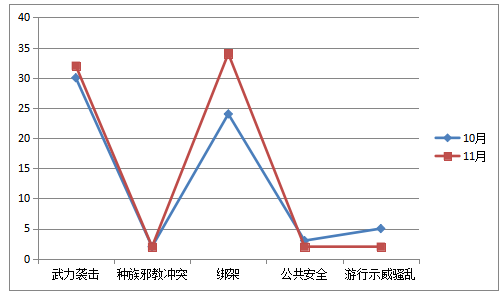
The 79 security incidents in November 2025 were categorized as follows:
- 32 armed attacks (40% of the total)
- 34 armed abductions (43% of the total)
- 2 public safety incidents (2% of the total)
- 9 military clearance operations (11% of the total)
- 2 protests and demonstrations (2.5% of the total)
No ethnic conflict-related incidents were recorded this month. Collectively, these events caused 193 deaths (114 civilians, 43 military/police personnel, and 36 neutralized terrorists) and at least 648 abductions. The overall security landscape exhibited the following key characteristics:
(1) Extremely High Security Risks in Central, Northwestern, and Northeastern Nigeria
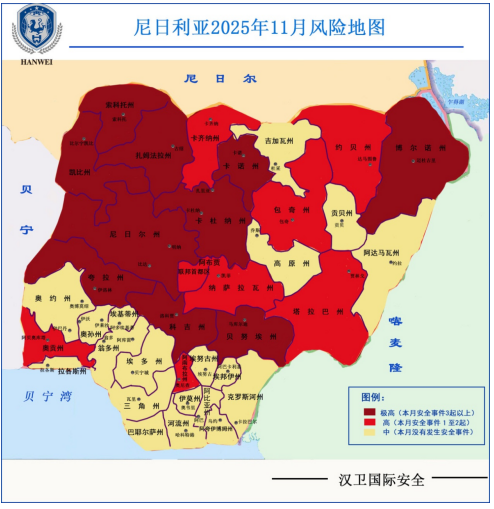
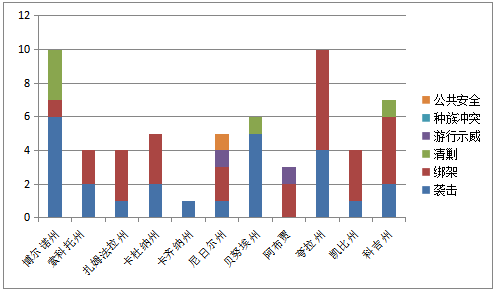
In November, security incidents were concentrated in northeastern Borno State, central Kogi State, Kwara State, and Kano State, with north-central Kaduna State, Niger State, and northwestern Zamfara State also designated as high-risk areas.
- **Kwara State (central) and Borno State (northeastern)** recorded the highest security risks, with 10 incidents each (up 4 and 5 from the previous month, respectively), predominantly armed attacks and abductions. These incidents resulted in 45 deaths and 71 abductions. Notably, Kwara State’s security situation deteriorated drastically as the new extremist group *Jama’at Nasr al-Islam wal Muslimin (JNIM)* established joint bases with local militant group *Lakurawa* in northern Kwara, conducting rampant kidnapping-for-ransom and cross-border smuggling activities. On November 23, JNIM claimed its first attack on a Nigerian military outpost in Kwara State, confirming its military presence in the region.
Hanwei International’s West Africa-based security officers issued **two security alerts** in November:
1. On November 16, they warned that armed bandits planned to launch attacks and abduct foreign nationals along the Kontagora-Birnin Yauri National Highway in Kebbi and Niger States. Chinese-funded enterprises and citizens in these areas were advised to avoid non-essential travel, suspend field operations, and evacuate to safe urban zones or leave the affected states.
2. On November 23, another alert warned of imminent attacks on foreign-funded enterprises and abductions of foreign citizens in Ogun State, urging heightened vigilance and security precautions for local Chinese entities and nationals.
Additionally, the UK government issued a security advisory on November 9, advising British citizens to avoid travel to Borno, Yobe, Adamawa, Gombe, Katsina, and Zamfara States due to high threats from *Boko Haram* and *Islamic State West Africa Province (ISWAP)*—particularly at transportation hubs, religious sites, and large gathering venues. It also recommended avoiding non-essential travel to Bauchi, Kaduna, Kano, Kebbi, Jigawa, Sokoto, Niger, Kogi, Plateau, Taraba States, and the capital Abuja.
*Figure 1: November Security Incident Distribution Map
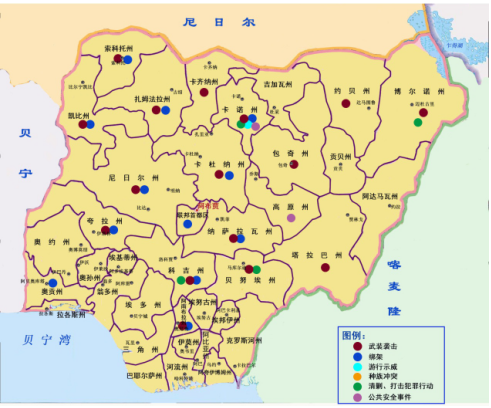
Chart 1: November Security Incident Statistics by Major Regions
(2) Surge in Abductions Triggers National State of Emergency
In November, 66 armed attacks and abduction incidents accounted for **83% of all security events**, resulting in 146 deaths and at least 648 abductions. Compared with October, the number of such incidents rose by 12, the death toll increased by 12, and abductions skyrocketed by 504. Statistics show 18 abduction cases involved over 10 victims each in November. The November 21 school kidnapping in Niger State, which saw 315 people taken hostage, surpassed the 2014 Chibok abduction (276 victims) to become Nigeria’s largest single mass abduction on record. The resurgence of large-scale abductions—especially targeting schools—has severely disrupted public life: numerous schools nationwide have closed, and citizens are boycotting major public events over fears of attacks or abductions. Plateau, Katsina, and Taraba States have ordered the closure of all state-run schools, while large numbers of residents in Kano State have fled their homes.
To address the crisis, Nigerian authorities implemented multiple measures:
- On November 24, the Nigerian Senate launched a series of security summits across six geopolitical zones to devise solutions for reversing the security decline. At the South-South regional summit, Rivers State Governor Siminalayi Fubara called for a decentralized security framework and enhanced inter-agency intelligence sharing. At the Northeast summit, Borno State Governor Babagana Zulum proposed building a *community-driven security network* to counter kidnappings and violent attacks.
- On November 26, President Bola Tinubu declared a national security state of emergency, mandating the recruitment of 20,000 additional police officers (raising the total planned recruitment to 50,000) and deploying all trained forest rangers to combat terrorists and bandits hiding in national forests. Media analysis notes that while the emergency order will strengthen counter-terrorism efforts and curb attacks, it may disrupt daily life through school/business closures, travel restrictions, communication disruptions, and regular curfews.
- On November 27, the Nigerian Senate voted to impose the **death penalty** for convicted kidnappers, marking a significant escalation in Nigeria’s legal crackdown and entry into an era of "zero tolerance" for abductions.
Furthermore, the UN Food and Agriculture Organization (FAO) warned in a November 24 report that Nigeria could face a severe food crisis by 2026 if current security conditions and humanitarian aid gaps persist, with up to 35 million people at risk of acute hunger or famine. The report cited worsening security in northern and central Nigeria as the primary driver of the crisis: armed attacks, abductions, and terrorist activities have displaced farmers, left vast farmlands uncultivated, and destroyed critical food supply chains (including transportation, livestock farming, and local markets).
(3) U.S. Threat of Military Intervention Sparks Strong Backlash
On November 1, U.S. President Donald Trump stated on Truth Social that the U.S. would launch direct military intervention if Nigeria’s government failed to "act quickly" to curb violence against Christians. The remarks triggered widespread condemnation in Nigeria and across Africa:
- On November 3, prominent Nigerian Islamic cleric Ahmad Gumi denounced the threat as an insult to Nigeria’s sovereignty and called for an immediate diplomatic response from the government.
- On November 8, Nigeria’s Islamic Movement (IM) held large-scale protests in the northern city of Kano to oppose Trump’s threat of military intervention under the pretext of "protecting Christians."
- On November 12, African Union Commission Chair Moussa Faki Mahamat stated at the UN headquarters in New York that no genocide was occurring in northern Nigeria, noting that *Boko Haram*’s first victims were Muslims, not Christians.
- A Nigerian federal government spokesperson also noted that Trump’s comments had distorted international perceptions of Nigeria’s security situation and provided new propaganda opportunities for local terrorist and criminal groups. Recent incidents—including school kidnappings and church attacks—indicate extremists are exploiting global media attention to escalate violence.
(4) Lassa Fever and Malaria Threaten Public Health
Lassa Fever Outbreak Remains Severe
The Nigeria Centre for Disease Control and Prevention (NCDC) reported that as of November 16, 8,679 suspected Lassa fever cases, 995 confirmed cases, and 184 deaths had been recorded across 106 local government areas in 21 states, with a **case fatality rate (CFR) of 18.5%** (higher than the 16.8% rate in the same period in 2024). Compared with October, suspected cases rose by 639, confirmed cases by 60, and deaths by 10. Ondo, Edo, Taraba, and Bauchi States accounted for 67% of all confirmed cases, remaining the epicenters of the outbreak.
Malaria Cases Surge Nationwide
Nigeria’s Federal Ministry of Health and Social Welfare reported that malaria cases had risen steadily between January and September 2025, with at least **24.47 million positive tests** recorded. Testing volumes increased from 10.5 million (Jan–Mar) to 11.4 million (Apr–Jun) and 12.8 million (Jul–Sep), totaling 34.8 million tests over nine months, with positive cases rising in tandem. At the 2025 Joint Annual Review Meeting in Abuja, Minister of State for Health and Social Welfare Dr. Iziak Sarako noted significant progress in the national malaria eradication program but emphasized the need for expanded interventions to curb transmission.
(5) Intensified Military Clearance and Anti-Crime Operations
Amid worsening security, Nigerian military and police forces ramped up clearance operations, neutralizing large numbers of militants in November:
- On November 10, Nigerian Army units launched coordinated nationwide operations, killing 7 terrorists and arresting 27 suspects.
- On November 23, the Nigerian Army’s 6th Brigade initiated *Operation Zafin Uta* to target militants in the Ukari and Takum areas of Taraba State.
- On November 29, the Nigerian Ministry of Defense’s Media Operations Directorate reported that over the preceding week, the military had intensified clearance efforts across multiple fronts, killing dozens of terrorists, arresting 57 suspects, rescuing 45 hostages, seizing large quantities of weapons/vehicles/ammunition, and dismantling multiple criminal and terrorist networks:
- Northeast Front**: *Operation Hadin Kai* forces killed numerous terrorists and destroyed several militant camps.
- Northwest and North-Central Fronts**: *Operation Fasaan Yama* covered Zamfara, Kebbi, Sokoto, Katsina, Kaduna, and Niger States, neutralizing terrorists and bandits, arresting 15 suspects, and rescuing 13 hostages.
- North-Central Front**: Joint operations under *Operation Safe Haven* and *Operation Whirlwind Strike* eliminated large numbers of extremists, arrested 11 suspects, rescued 19 hostages, and seized weapons, vehicles, and illegal funds.
- Niger Delta Front**: *Operation Delta Safe* foiled an oil theft ring worth over 173 million Naira, destroyed 11 illegal refineries, and arrested 13 criminals.
- Southeast Front**: *Operation Udoka* conducted coordinated airstrikes in Enugu State, clearing multiple terrorist hideouts, rescuing 5 hostages, and arresting 7 criminals.
*Chart 2: November Security Incident Classification Comparison*
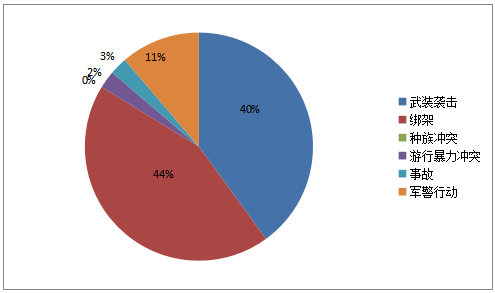
*Chart 3: November Death Toll Classification Statistics*
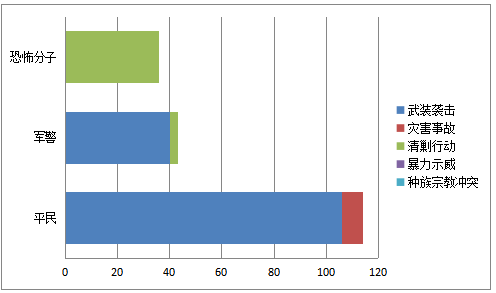
*Chart 4: Comparison of Major Security Incident Counts (November vs. October)*
II. Risk Warnings and Prevention Recommendations
Given Nigeria’s complex social environment and high-risk security rating, the following precautions are recommended: 1. Implement 24/7 Security for All Travel** Remote rural areas of Nigeria face limited police resources, poor road infrastructure, and delayed security force responses to violent crime and riots. Chinese-funded enterprises must obtain real-time local security intelligence, conduct destination-specific risk assessments, and ensure armed security escorts for all travel. 2. Heighten Vigilance Against Kidnapping Risks** Mass abductions surged in November, with the number of hostages tripling from the previous month. On November 22, the Chinese Embassy in Nigeria issued an alert warning of sharply deteriorating security, citing frequent protests, riots, armed attacks, and kidnappings. The embassy and Consulate General in Lagos urged Chinese enterprises and citizens to discard complacency, strengthen security protocols for travel and premises, and safeguard personal and property safety. 3. Effectively Mitigate Targeted Threats** Most attacks occur in the northeast and north-central regions, particularly central Maiduguri (Borno State), roads connecting major towns, areas bordering Niger, and Zamfara State. Kaduna State and Abuja have also seen a spike in incidents. In the event of a terrorist attack, follow official directives and contact designated security providers immediately for assistance. - Install video surveillance at residences, businesses, warehouses, and camps; equip camps with trenches, high walls, barbed wire, anti-ramming barriers, buffer zones, and alarms; and expand security perimeters with additional military/police personnel. - Avoid lingering near potential attack targets, including government/security facilities, landmarks, and religious sites. Minimize time spent in crowded public areas such as northeastern Nigeria, religious venues, ethnically mixed zones, high-crime areas (highways, Gulf of Guinea piracy hotspots), oil/gas infrastructure, military barracks, embassies, schools, markets, refugee camps, and transportation hubs.